
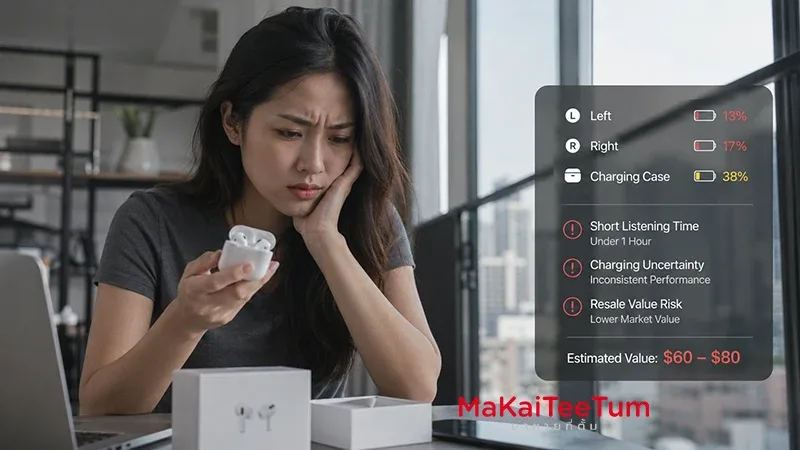
AirPods are easy to resell, but they are also one of the Apple products buyers should inspect most carefully. Unlike an iPhone, AirPods do not provide a simple Battery Health percentage in Settings. That means a pair can look clean, sound normal at first, and still have weak battery performance that lowers its second-hand market value.
For sellers, knowing the battery condition helps set a fair price before listing or trading in. For buyers, it helps avoid a deal that looks cheap but becomes frustrating after a few days of real use. This guide explains how AirPods battery degradation appears, how to test it before buying or selling, and when it makes more sense to sell, keep, or upgrade.
What Does AirPods Battery Degradation Mean?
AirPods use small lithium-ion batteries inside each earbud and the charging case. Over time, these batteries chemically age. As they age, they hold less charge, deliver shorter listening time, and may behave less predictably during calls, music playback, or charging.
- Listening time becomes noticeably shorter
- One earbud drains faster than the other
- The charging case loses power quickly
- AirPods shut down even when battery still appears available
- Charging becomes inconsistent or unstable
Because AirPods do not show a dedicated battery health percentage like iPhones, the most reliable approach is to evaluate real-world usage time, charging behavior, and battery balance between the left and right earbuds.
Clear Signs That AirPods Battery Is Getting Weak
Listening Time Drops Sharply
The most obvious warning sign is shorter daily use. If the AirPods used to last for hours but now struggle through a short commute or meeting, the battery may be losing capacity.
Left and Right Earbuds Drain Unevenly
It is common for one AirPod to age faster than the other, especially if it handles microphone duties more often. However, a large gap between left and right battery levels is a strong second-hand buying red flag.
The Charging Case No Longer Holds Power Well
Sometimes the earbuds are still usable, but the case battery becomes the weak point. If the case can no longer recharge the earbuds multiple times, resale value drops.
Battery Percentage Jumps or AirPods Shut Down Early
If the battery jumps from a high percentage to low battery warnings quickly, or the AirPods shut off unexpectedly, the battery may no longer be delivering stable power.
How to Check AirPods Battery Before Buying or Selling
Check Battery Percentage on iPhone
Open the AirPods case near an iPhone and review the pop-up battery display for the left earbud, right earbud, and case. You can also use the iPhone Battery Widget to monitor connected accessories more consistently.
Run a 30–60 Minute Real-World Test
Battery percentage alone does not tell the full story. Play music, watch a video, or join a call for at least 30–60 minutes and observe how quickly each side drains.
Test Calls and Microphone Use
Calls often consume more power than simple music playback. If the AirPods perform poorly during calls, battery wear or microphone-related issues may be present.
Charge Fully and Leave Overnight
Charge both earbuds and the case to full, then leave them unused overnight. If the battery drops significantly without use, the case or earbuds may not be holding charge properly.
Why Weak AirPods Battery Reduces Resale Value
AirPods resale value depends heavily on real usable battery life. Buyers care less about the original retail price and more about whether the earbuds can last through commuting, workouts, calls, or work sessions.
- Short battery life lowers daily usability
- Buyers worry about replacement costs
- AirPods battery repair is less straightforward than larger Apple devices
- Older models carry higher battery-risk perception
- A weak charging case reduces the value of the full set
In many used AirPods deals, strong battery performance matters more than light cosmetic scratches. A small scratch may be acceptable, but unreliable battery life affects every use.
Which AirPods Models Need Extra Battery Checking?
AirPods Older Than 2–3 Years
With daily use, AirPods that are more than two or three years old often begin showing shorter battery life, especially if they were used for long calls, meetings, or daily commuting.
AirPods Pro With Heavy ANC Use
Active Noise Cancellation uses more power than basic listening. AirPods Pro models used heavily with ANC may show battery wear sooner than lightly used pairs.
AirPods Stored Unused for a Long Time
Low usage does not always mean better battery condition. Lithium-ion batteries can degrade if stored empty or unused for long periods.
What Else Should You Check Before Buying Used AirPods?
Serial Number and Authenticity
AirPods are frequently counterfeited. Before buying used, verify the serial number through Apple’s official coverage system and compare device details shown in iPhone Settings.
Sound and Microphone Quality
Test music playback, phone calls, and voice recording. Distorted speakers, weak microphones, or uneven sound balance can reduce second-hand value.
Charging Case and Port Condition
Inspect the charging case, hinge, status light, charging port, and cleanliness. A worn case often reveals how heavily the AirPods were used.
When Is the Best Time to Sell AirPods?
Sell Before the Battery Becomes Unreliable
If battery life is shorter than before but still usable, selling earlier can preserve more value than waiting until the earbuds shut down unexpectedly or fail to charge.
Sell While the Model Is Still Relevant
AirPods with current features like Spatial Audio, ANC, USB-C, or strong Apple ecosystem compatibility usually remain easier to resell than much older models.
Sell Before Upgrading
If you already plan to upgrade, checking trade-in or resale value first helps you decide whether to sell now or keep the AirPods as a backup pair.
Should You Keep Using Them or Sell Them?
Keep Them If:
- Battery life is still close to normal
- Both earbuds drain at a similar rate
- The case still provides multiple recharges
- Sound, microphone, and connectivity remain stable
Sell Them If:
- Battery drains much faster than expected
- One earbud dies far earlier than the other
- The case no longer holds charge well
- Charging or audio issues are starting to appear
- You already plan to upgrade to a newer model
For AirPods, waiting until the battery becomes severely degraded often reduces resale value quickly. Buyers usually test battery performance, and weak results can lead to lower offers or no sale at all.
Why You Should Get a Price Estimate Before Selling AirPods
AirPods resale pricing depends on model, condition, battery behavior, charging case condition, included accessories, and current market demand. A visual check alone is not enough to understand true market value.
MaKaiTeeTum provides Apple device buyback services for AirPods, iPhone, iPad, MacBook, iMac, and Apple Watch. The process is designed for sellers who want a quick valuation, fast inspection, and immediate payment after agreement.
- Fast inspection in around 10 minutes
- Pricing based on real model and condition
- Pickup service available in supported areas
- Immediate payment after verification
- Privacy-focused handling with no personal data retention
Quick Decision Summary
- AirPods do not show Battery Health like iPhone
- Short listening time is the clearest battery-wear sign
- Uneven left-right battery drain is a major warning signal
- Test AirPods for at least 30–60 minutes before buying used
- AirPods older than 2–3 years need closer battery inspection
- Selling before battery degradation becomes severe usually protects resale value
- Always check serial number, sound, microphone, case, and charging behavior
If you are unsure whether your AirPods still have good resale value, you can request an initial estimate by sending the model and condition through LINE: @KunTum, visit makaiteetum.com, or call 08-1154-5496.
References
https://support.apple.com/en-us/119912
https://support.apple.com/en-us/102593
https://support.apple.com/en-my/guide/airpods/devde25a4bbe/web